CCNA Answers – CCNA Exam – CCNA Exams – CCNA Module-1-2-3-4: CCNA Module 5 Answers

ad

Showing posts with label CCNA Module 5 Answers. Show all posts

Monday, 30 July 2012

CCNA 3 Chapter 5 V4.0 Answers


1. Which two criteria does a switch use to select the root bridge? (Choose two.)
bridge priority
switching speed
number of ports
base MAC address
switch location
memory size

2. Which two statements are true about the default operation of STP in a Layer 2 switched environment that has redundant connections between switches? (Choose two.)
The root switch is the switch with the highest speed ports.
Decisions on which port to block when two ports have equal cost depend on the port priority and identity.
All trunking ports are designated and not blocked.
Root switches have all ports set as root ports.
Non-root switches each have only one root port.

3.
CCNA3Chapter5V4.0Answers1 thumb CCNA 3 Chapter 5 V4.0 Answers
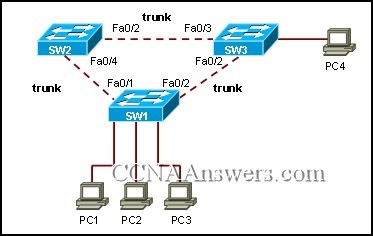
Refer to the exhibit. All switches in the network have empty MAC tables. STP has been disabled on the switches in the network. How will a broadcast frame that is sent by host PC1 be handled on the network?
Switch SW1 will block the broadcast and drop the frame.
Switch SW1 will forward the broadcast out all switch ports, except the originating port. This will generate an endless loop in the network.
Switch SW1 will forward the broadcast out all switch ports, except the originating port. All hosts in the network will reply with a unicast frame sent to host PC1.
Switch SW1 will forward the traffic out all switch ports except the originating port as a unicast frame. All hosts in the network will reply with a unicast frame sent to switch SW1.

4. Which two statements describe the BIDs used in a spanning tree topology? (Choose two.)
They are sent out by the root bridge only after the inferior BPDUs are sent.
They consist of a bridge priority and MAC address.
Only the root bridge will send out a BID.
They are used by the switches in a spanning tree topology to elect the root bridge.
The switch with the fastest processor will have the lowest BID.

5. Which statement or set of paired statements correctly compares STP with RSTP?
STP and RSTP have the same BPDU format and flag field information.
STP specifies backup ports. RSTP has only root ports, alternate ports, and designated ports.
STP port states are independent of port roles. RSTP ties together the port state and port role.
STP waits for the network to converge before placing ports into forwarding state. RSTP places designated ports into forwarding state immediately.

6. How can a network administrator influence which STP switch becomes the root bridge?
Configure all the interfaces on the switch as the static root ports.
Change the BPDU to a lower value than that of the other switches in the network.
Assign a lower IP address to the switch than that of the other switches in the network.
Set the switch priority to a smaller value than that of the other switches in the network.

7. In which STP state does a port record MAC addresses but not forward user data?
blocking
learning
disabling
listening
forwarding

8. When PVST+ was developed, the Bridge ID was modified to include which information?
bridge priority
MAC address
protocol
VLAN ID

9. What is the first step in the process of convergence in a spanning tree topology?
election of the root bridge
blocking of the non-designated ports
selection of the designated trunk port
determination of the designated port for each segment

10. What two elements will exist in a converged network with one spanning tree? (Choose two.)
one root bridge per network
all non-designated ports forwarding
one root port per non-root bridge
multiple designated ports per segment
one designated port per network

11.
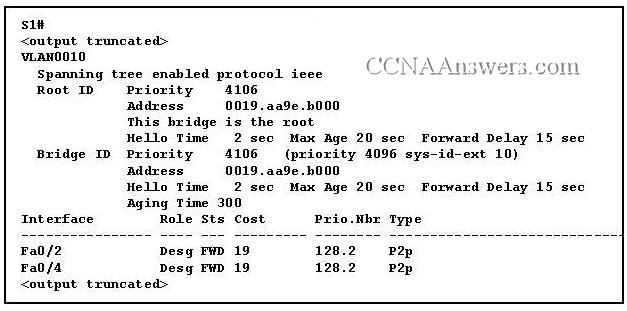
CCNA3Chapter5V4.0Answers2 thumb CCNA 3 Chapter 5 V4.0 Answers
Refer to the exhibit. What can be determined from the output shown?
Two hosts communicating between ports Fa0/2 and Fa0/4 have a cost of 38.
The priority was statically configured to identify the root.
STP is disabled on this switch.
The timers have been altered to reduce convergence time.

12. What two features of the Spanning-Tree Protocol contribute to the time it takes for a switched network to converge after a topology change occurs? (Choose two.)
the max-age timer
the spanning-tree hold down timer
the forward delay
the spanning-tree path cost
the blocking delay

13. What three link types have been defined for Rapid Spanning-Tree Protocol? (Choose three.)
shared
end-to-end
edge-type
boundary-type
point-to-many
point-to-point

14.
CCNA3Chapter5V4.0Answers3 thumb CCNA 3 Chapter 5 V4.0 Answers
Refer to the exhibit. The spanning-tree port priority of each interface is at the default setting. The network administrator enters the spanning-tree vlan 1 root primarycommand on S4. What is the effect of the command?
Spanning tree blocks Gi0/1 on S3.
Gi0/2 on S3 transitions to a root port.
Port priority makes Gi0/2 on S1 a root port.
S4 is already the root bridge, so there are no port changes.

15. In which two ways is the information that is contained in BPDUs used by switches? (Choose two.)
to negotiate a trunk between switches
to set the duplex mode of a redundant link
to identify the shortest path to the root bridge
to prevent loops by sharing bridging tables between connected switches
to determine which ports will forward frames as part of the spanning tree

16. What Rapid Spanning Tree Protocol (RSTP) role is assigned to the forwarding port elected for every Ethernet LAN segment that links two switches?
alternate
backup
designated
edge

17. Which two items are true regarding the spanning-tree portfast command? (Choose two.)
PortFast is Cisco proprietary.
PortFast can negatively effect DHCP services.
PortFast is used to more quickly prevent and eliminate bridging loops.
Enabling PortFast on trunks that connect to other switches improves convergence.
If an access port is configured with PortFast, it immediately transitions from a blocking to a forwarding state.

18. Which two actions does an RSTP edge port take if it receives a BPDU? (Choose two.)
immediately loses its edge status
inhibits the generation of a TCN
goes immediately to a learning state
disables itself
becomes a normal spanning-tree port

19.
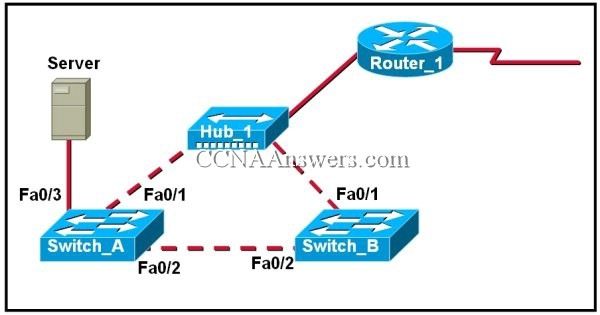
CCNA3Chapter5V4.0Answers4 thumb CCNA 3 Chapter 5 V4.0 Answers
Refer to the exhibit. Server sends an ARP request for the MAC address of its default gateway. If STP is not enabled, what will be the result of this ARP request?
Router_1 will drop the broadcast and reply with the MAC address of the next hoprouter.
Switch_A will reply with the MAC address of the Router_1 E0 interface.
Switch_A and Switch_B will continuously flood the message onto the network.
The message will cycle around the network until its TTL is exceeded.

20. Which three statements are accurate regarding RSTP and STP? (Choose three.)
RSTP uses a faster algorithm to determine root ports.
RSTP introduced the extended system ID to allow for more than 4096 VLANs.
Both RSTP and STP use the portfast command to allow ports to immediately transition to forwarding state.
Like STP PortFast, an RSTP edge port that receives a BPDU loses its edge port status immediately and becomes a normal spanning-tree port.
Configuration commands to establish primary and secondary root bridges are identical for STP and RSTP.
Because of the format of the BPDU packet, RSTP is backward compatible with STP.
Tuesday, 24 July 2012

CCNA 1 Chapter-5 Network Fundamentals (V4.0) Answer


1. In an IPv4 environment, what information is used by therouter to forward data packets from one interface of a router to another?
destination network address
source network address
source MAC address
well known port destination address

2. What information is added during encapsulation at OSI Layer 3?
source and destination MAC
source and destination application protocol
source and destination port number
source and destination IP address


3. In a connectionless system, which of the following is correct?
The destination is contacted before a packet is sent.
The destination is not contacted before a packet is sent.
The destination sends an acknowledgement to the source that indicates the packet was received.
The destination sends an acknowledgement to the source that requests the next packet to be sent.

4. Which IP packet field will prevent endless loops?
type-of-service
identification
flags

time-to-live
header checksum

5. Which portion of the network layer address does a router use to forward packets?
host portion
broadcast address
network portion
gateway address

6.
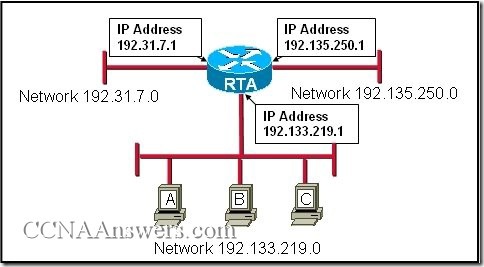
CCNA1Chapter51 thumb CCNA 1 Chapter 5 V4.0 Answers
Refer to the exhibit. Using the network in the exhibit, what would be the default gateway address for host A in the 192.133.219.0 network?
192.135.250.1
192.31.7.1
192.133.219.0
192.133.219.1

7. If the default gateway is configured incorrectly on the host, what is the impact on communications?
The host is unable to communicate on the local network.
The host can communicate with other hosts on the local network, but is unable to communicate with hosts on remote networks.
The host can communicate with other hosts on remote networks, but is unable to communicate with hosts on the local network.
There is no impact on communications.

8. What is the purpose of a default gateway?
physically connects a computer to a network
provides a permanent address to a computer
identifies the network to which a computer is connected
identifies the logical address of a networked computer and uniquely identifies it to the rest of the network
**identifies the device that allows local network computers to communicate with devices on other networks

9. What type of routing uses information that is manually entered into the routing table?
dynamic
interior
static
standard

10. When the destination network is not listed in the routing table of a Cisco router, what are two possible actions that the router might take? (Choose two.)
The router sends an ARP request to determine the required next hop address.
The router discards the packet.
The router forwards the packet toward the next hop indicated in the ARP table.
The router forwards the packet to the interface indicated by the source address.
The router forwards the packet out the interface indicated by the default route entry.

11. What are the key factors to consider when grouping hosts into a common network? (Choose three.)
gateways
purpose
physical addressing
software version
geographic location
ownership

12. What is a component of a routing table entry?
the MAC address of the interface of the router
the destination Layer 4 port number
the destination host address
the next-hop address

13. Which intermediary devices could be used to implement security between networks? (Choose two.)
router
hub
switch
firewall
access point
bridge

14. What are three common problems with a large network? (Choose three.)
too few broadcasts
performance degradation
security issues
limited management responsibility
host identification
protocol compatibility

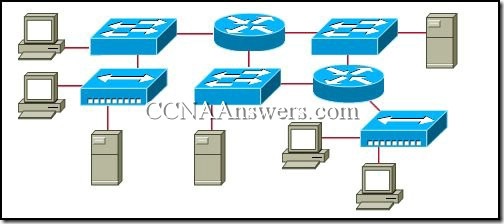
15.
3
4
5
7
8
11

16. Which three statements are true about routes and their use? (Choose three.)
If no route to the destination network is found, the packet is returned to the previous router.
If the destination network is directly connected, the router forwards the packet to the destination host.
If multiple network entries exist for the destination network, the most general route is used to forward the packet.
If no route exists for the destination network and a default route is present, the packet is forwarded to the next-hop router.
If the originating host has a default gateway configured, the packet for a remote network can be forwarded using that route.
If a host does not have a route manually configured for the destination network, the host will drop the packet.

17.
CCNA1Chapter53 thumb CCNA 1 Chapter 5 V4.0 Answers
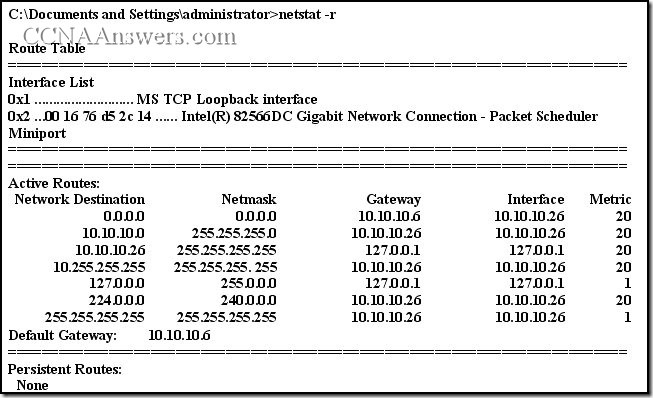
Refer to the exhibit. A network administrator is troubleshooting a connectivity problem and needs to determine the address that is used to forward network packets out the network. Using the netstat -r command, the administrator would identify which address as the address to which all hosts send packets that are destined for an outside network?
10.10.10.26
127.0.0.1
10.10.10.6
10.10.10.1
224.0.0.0

18.
CCNA1Chapter54 thumb CCNA 1 Chapter 5 V4.0 Answers
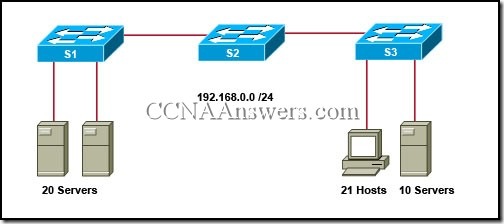
Refer to the exhibit. A network administrator notices that there are too many broadcasts on the network. What two steps can the network administrator take to resolve this problem? (Choose two.)
Replace S2 with a router.
Place all servers on S1.
Disable TCP/IP broadcasts.
Subnet the 192.168.0.0 /24 network.
Disable all unused interfaces on the switches.

19.
CCNA1Chapter55 thumb CCNA 1 Chapter 5 V4.0 Answers
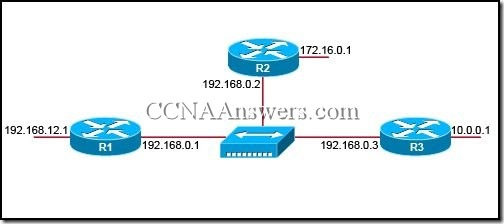
Refer to the exhibit. The network in the exhibit is fully operational. What two statements correctly describe the routing for the topology that is shown? (Choose two.)
192.168.0.2 is the next-hop address that is used by R3 to route a packet from the 10.0.0.0 network to the 172.16.0.0 network.
10.0.0.1 is the next-hop address that is used by R1 to route a packet from the 192.168.12.0 network to the 10.0.0.0 network.
192.168.0.1 is the next-hop address that is used by R1 to route a packet from the 192.168.12.0 network to the 172.16.0.0 network.
172.16.0.1 is the next-hop address that is used by R3 to route a packet from the 10.0.0.0 to the 172.16.0.0 network.
192.168.0.1 is the next-hop address that is used by R2 to route a packet from the 172.16.0.0 network to the 192.168.12.0 network.
192.168.0.2 is the next-hop address that is used by R2 to route a packet from the 172.16.0.0 network to the 192.168.12.0 network.

20. What two characteristics are commonly associated with dynamic routing protocols? (Choose two.)
require no device configuration
provide routers with up-to-date routing tables
require less processing power than static routes require
consume bandwidth to exchange route information
prevent manual configuration and maintenance of the routing table

21. What statement describes the purpose of a default route?
A host uses a default route to transfer data to another host on the same network segment.
A host uses a default route to forward data to the local switch as the next hop to all destinations.
A host uses a default route to identify the Layer 2 address of an end device on the local network.
A host uses a default route to transfer data to a host outside the local network when no other route to the destination exists.